

Built for the Field: High-Output Alternator for Hard-Use Polaris Ranger Diesels | Mechman®
Polaris Ranger Diesel · Hard-Use Charging
Built for the Field: Why Hard-Use Operators Run Diesel — and Demand More Alternator
The same traits that make a diesel Ranger a favorite of military, agency, and off-grid die-hards are the traits that outrun its factory charging system.
Ask a rancher, a backcountry hunter, a search-and-rescue volunteer, or a base motor pool why they run a diesel UTV instead of a gas one, and you'll hear a version of the same answer: one fuel, more range, more torque, fewer surprises. The Polaris Ranger Diesel was built for people who can't afford to be stranded — and that mindset is exactly why its owners outgrow the factory charging system.
Why diesel is the hard-use operator's choice
For military and expeditionary users, the appeal of diesel isn't a slogan — it's logistics. Since the 1980s, NATO and the U.S. military have pushed toward a single-fuel concept, standardizing ground vehicles, generators, and even aircraft on one diesel-family fuel (JP-8/F-34) to simplify supply lines in the field. A diesel powerplant fits that world: it shares fuel with the trucks, the generators, and the gear already in the convoy.
The same logic wins over civilian die-hards for different reasons:
- Range and economy — diesel sips fuel and Polaris gave the Ranger Diesel a large tank, so it works longer between fills.
- Low-end torque — for towing, plowing, and crawling fully loaded.
- One fuel on the property — the same diesel that runs the tractor, the generator, and the work truck.
- Durability — a cast-iron Kohler diesel built for rugged, continuous duty.
Mechman® alternators aren't military-issued equipment, and we won't claim otherwise. The point is simpler: the kind of operator who chooses a diesel UTV for single-fuel reliability is the same operator who stacks the most electrical load onto it — and that's where factory charging falls short.
Hard use is electrical use
A Ranger that earns its keep is rarely just a Ranger. By the time it's set up for real work or real remote travel, it's carrying a small power grid:
- A winch for self-recovery — the single biggest momentary draw on the truck.
- Scene and trail lighting — light bars and pods for night operations.
- Communications — two-way radios, repeaters, GPS, and trackers that need rock-steady voltage to stay reliable.
- Auxiliary batteries and inverters — to run tools, charge devices, or power a camp far from any outlet.
- Cab climate control — heat and defrost on a cold pre-dawn start, fans in the heat.
The factory Kohler KDW1003 left the line with a 110-amp alternator. That's fine for stock. It is not fine for a winch that can pull more than the whole alternator makes, layered on top of lights, comms, and climate — and it's especially not fine at the low engine speeds where this work happens.
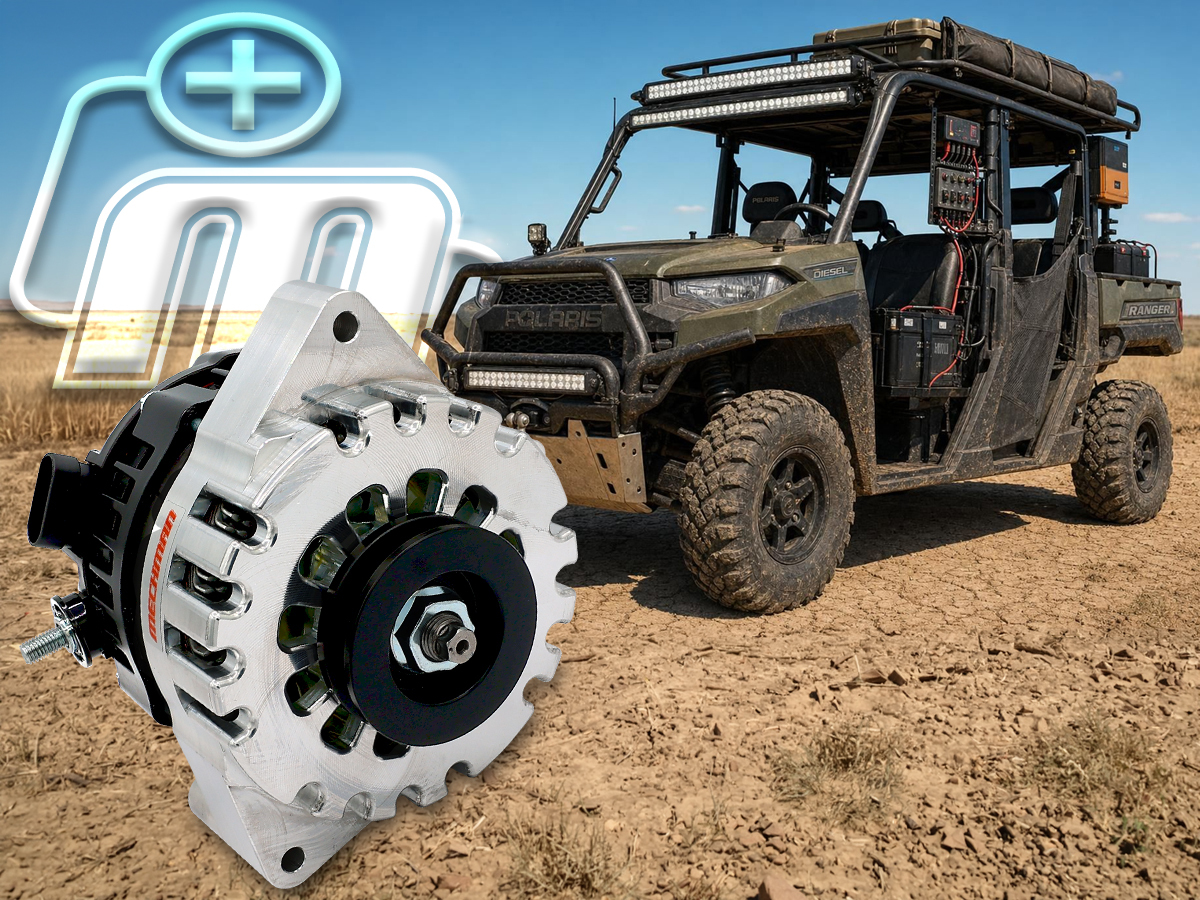
Mechman®'s 170-amp billet alternator (B21935170M) bolts into the factory location and adds 60 amps of headroom — built to hold output across the full RPM range, not just at speed.
Where austere conditions test a charging system
Heat, dust, water crossings, vibration, repeated cold cold-starts — austere duty punishes the charging system as much as the drivetrain. A sagging alternator shows up at the worst possible time: a winch that crawls when you're stuck, lights that dim mid-recovery, comms that drop, a battery too flat to crank after a long idle.
The Mechman 170-amp unit answers that with a CNC-machined billet case, a heavy-duty rectifier and regulator, and quality bearings — built to survive the environment, and to keep voltage stable while it does.
Headroom. With 170 amps on tap and stable low-RPM output, the winch pulls hard, the lights stay bright, the radios stay clean, and the battery comes back to full — even with everything running at once, miles from the nearest outlet.
A clean, no-drama install
For operators who maintain their own equipment, the upgrade is deliberately simple. The B21935170M is a direct bolt-in that uses the factory mounting points and belt routing — no brackets, no fabrication. It's internally regulated, so the electrical hookup needs only a keyed-ignition 12-volt trigger. Swap it, wire the trigger, go back to work.
It's built in Knoxville, Tennessee — the kind of in-house U.S. manufacturing you'd expect from a serious equipment supplier, not a rebranded import.
Fits the diesel Ranger family
Whichever diesel trim you run on the Kohler driveline, it's the same upgrade:
- Ranger Diesel (2015–2018)
- Ranger Diesel Crew (2015–2018)
- Ranger Diesel HST (2015–2017)
- Ranger Diesel HST Deluxe (2015–2017)
Frequently asked questions
Why do military and expeditionary users favor diesel UTVs?
Diesel fits the military's single-fuel concept — a NATO and U.S. policy dating to the 1980s that standardizes ground vehicles, generators, and land-based aircraft on one diesel-family fuel (JP-8/F-34) to simplify battlefield logistics. Diesel platforms also offer strong low-end torque, long range, and rugged durability, which is why the same reliability-first mindset appeals to agencies and off-grid civilian users.
Is the Mechman alternator military-issued or military-spec?
No. Mechman makes commercial high-output alternators and doesn't claim military issue. What we do claim is straightforward: the unit is USA-built and engineered for the heavy electrical loads that demanding operators put on a diesel Ranger.
I run a winch, lights, and a radio. Will the factory 110-amp alternator keep up?
Under sustained load, often not. A winch alone can momentarily draw more than the factory alternator's entire output; add lighting, comms, and climate control and you can exceed supply, which forces the battery to drain. The 170-amp Mechman unit adds 60 amps of headroom and holds output at the low RPM where this work usually happens.
How hard is the install in the field?
It's designed to be simple. The B21935170M is a direct bolt-in using the factory mounting points and belt routing — no brackets or modifications — and the internally regulated design needs only a keyed-ignition 12-volt trigger wire. It's a practical swap for an owner who maintains their own equipment.
Which Ranger Diesel models does it fit?
It fits the diesel Ranger trims sharing the Kohler driveline: Ranger Diesel and Crew Diesel (2015–2018), and the HST and HST Deluxe (2015–2017). It's the same B21935170M unit across the family — select your year and engine size at checkout to confirm.
Power that holds up where it counts
170-amp billet bolt-in for 2015–2021 Polaris diesel UTVs. USA-built in Knoxville, TN.