

How a 48V Secondary Alternator Powers a Mobile Off-Grid Trailer | Mechman®
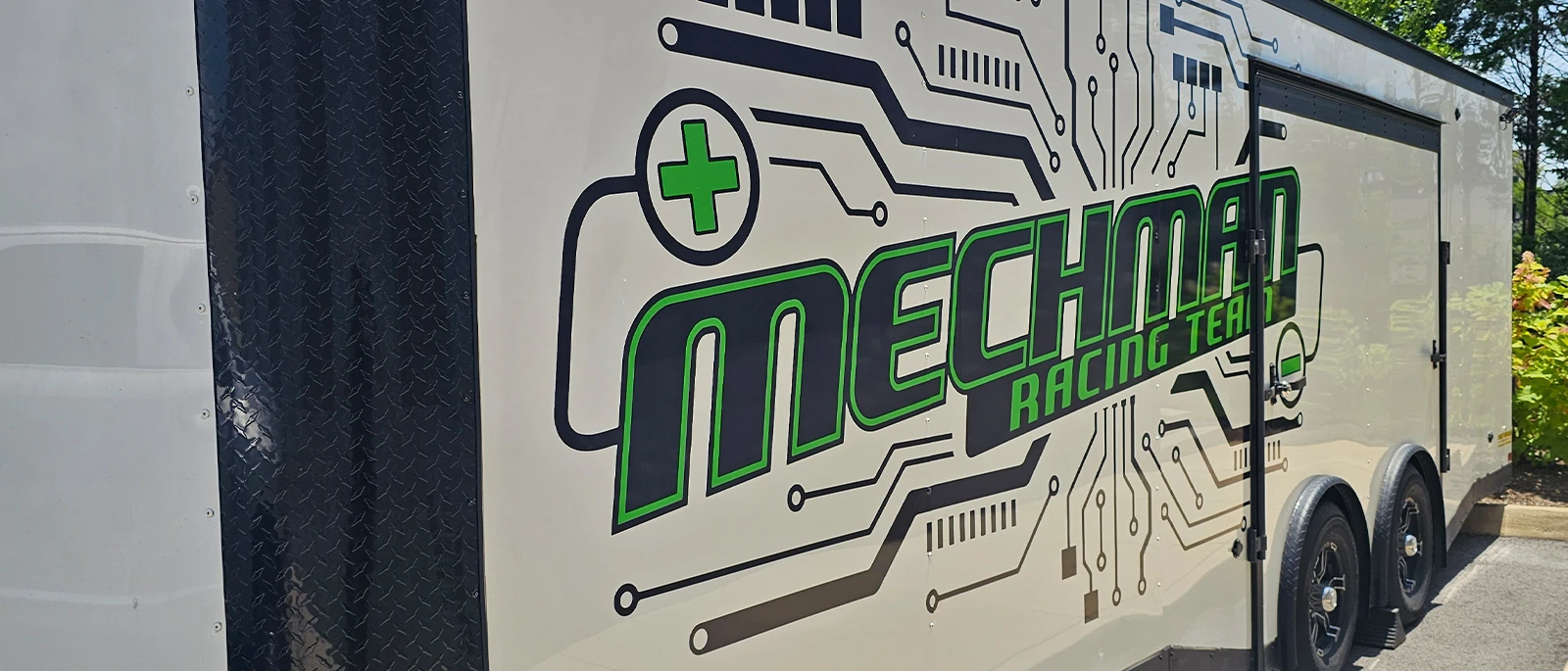
Solar can be an important part of the solution, but available sunlight, roof space, weather, and time can limit how quickly a large battery bank can be recharged.
A secondary 48V alternator creates another option: use the vehicle's engine as a high-output charging source while retaining the vehicle's existing electrical system.
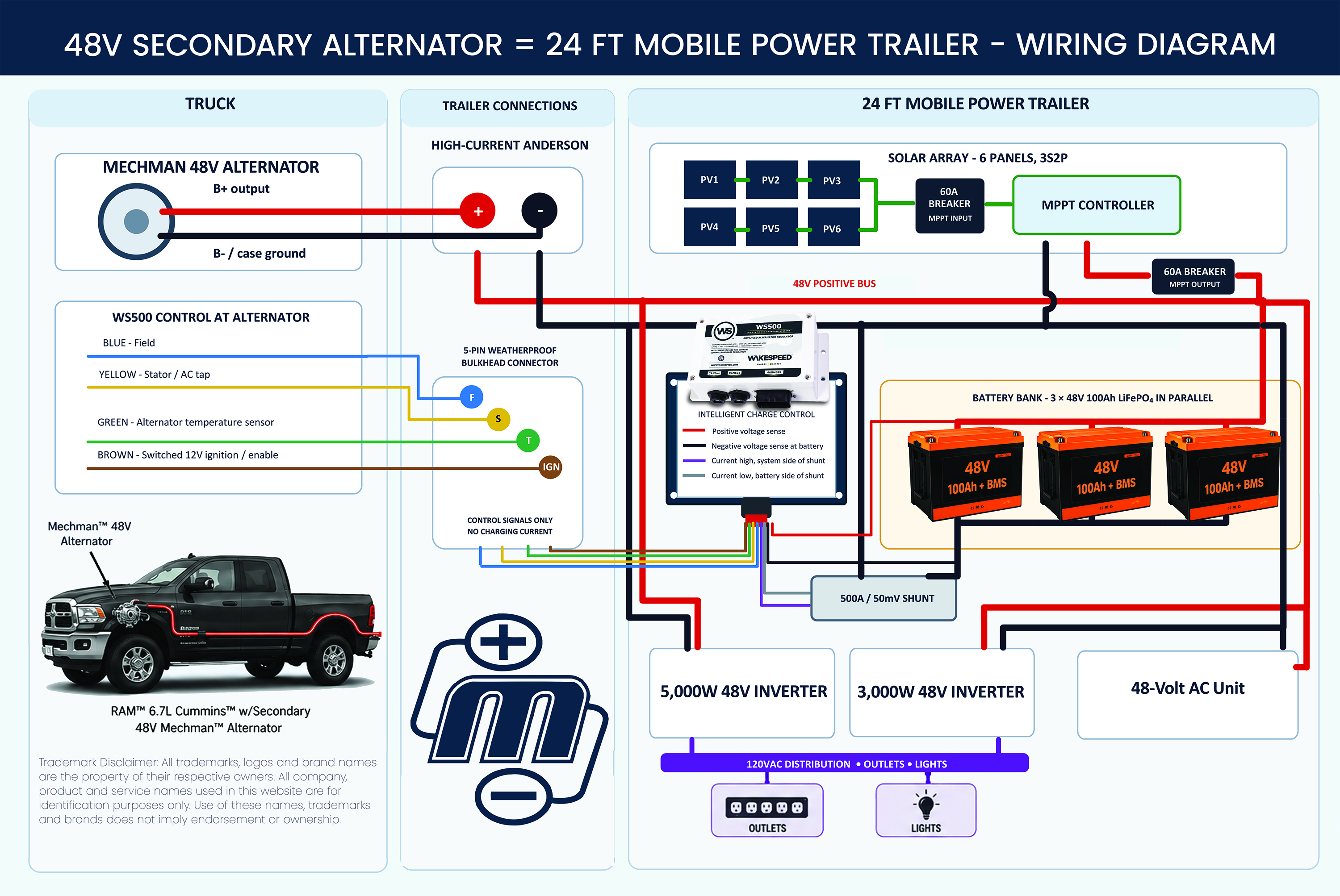
The system illustrated in this diagram shows how a Mechman® 48V secondary alternator installed on a RAM® truck equipped with a 6.7L Cummins® engine can connect to a 24-foot mobile power trailer containing a 48V lithium battery bank, solar charging, inverters, and a 48V air-conditioning unit.
The result is a mobile electrical system capable of accepting power from both the vehicle and the solar array — and storing that energy for use when and where it is needed.
The Basic Concept: The Truck Becomes Part of the Power System
The key to this design is the secondary alternator.
Rather than replacing the truck's factory charging system, the diagram shows a dedicated Mechman® 48V alternator providing the charging source for the trailer's 48V electrical system. This allows the auxiliary power system to serve a completely different purpose from the truck's normal vehicle electrical loads.
The alternator's positive and ground connections are routed from the truck to a high-current Anderson-style connection between the truck and trailer. This creates a disconnect point so the trailer can be separated from the tow vehicle when necessary.
When connected, the truck's 48V secondary alternator becomes one of the trailer's available charging sources.
Intelligent 48V Charge Control
Producing electrical power is only one part of a properly designed high-output charging system. That power also needs to be controlled.
The diagram incorporates a WS500 charge controller into the system. The controller receives several control inputs associated with alternator operation:
- Field control
- Stator / AC signal
- Alternator temperature sensing
- Switched 12V ignition / enable
The diagram also shows voltage and current sensing associated with the battery bank and shunt. This arrangement allows the charging system to monitor critical information rather than simply treating the alternator as an uncontrolled source of power.
Control Signals ≠ Charging Current
The lines running through the trailer connection for these functions are identified as control signals only — not charging current. The high-current charging path is handled separately through the heavy positive and negative connections.
What's in the Trailer
Energy Storage
48V Lithium Battery Bank
Three 48V 100Ah LiFePO4 batteries connected in parallel, each with its own BMS.
Monitoring
500A / 50mV Shunt
Installed on the battery side, feeding current-sensing data to the WS500 controller.
Solar Input
6-Panel Array (3S2P)
Feeds through a 60A breaker into an MPPT controller, with another 60A breaker on the output.
AC Conversion
5,000W 48V Inverter
Primary inverter supplying 120VAC distribution for outlets and lighting.
AC Conversion
3,000W 48V Inverter
Second inverter shown in the illustrated system alongside the 5,000W unit.
Native 48V Load
48V Air Conditioning
Connected directly to the 48V system — no inverter conversion step required.
The 48V Lithium Battery Bank
At the center of the trailer's electrical system is the battery bank. The diagram shows three 48V 100Ah LiFePO4 batteries connected in parallel. Because the batteries are shown in parallel, the system remains nominally 48V while increasing the available amp-hour capacity. Each battery is also depicted with its own BMS.
The battery bank serves as the energy reservoir for the trailer. Energy can be stored while the truck's engine is operating or when solar energy is available, then used later — even after the truck is shut down.
The alternator generates power when the engine is operating. The batteries are what allow that generated energy to be stored for later use.
Monitoring Current with a Shunt
The diagram incorporates a 500A / 50mV shunt on the battery side of the system. The WS500 controller is shown receiving current-sensing connections from the shunt.
This provides the control system with information about current flow at the battery bank, adding another layer of intelligence to the charging architecture.
Solar and Alternator Charging Can Work Together
Vehicle-powered charging does not mean solar has to disappear. In fact, this diagram demonstrates the opposite.
The trailer includes a six-panel solar array configured 3S2P. The solar array feeds through a 60A breaker into an MPPT controller, with another 60A breaker shown on the controller output before it connects to the 48V system. This creates two distinct energy sources:
Energy Source 01
Vehicle-Generated
- Mechman® 48V secondary alternator
- Produces while the engine is operating
- Independent of weather and daylight
- Routed through the Anderson-style connection
Energy Source 02
Solar-Generated
- Six-panel photovoltaic array (3S2P)
- Produces while parked, no engine required
- Depends on sunlight and conditions
- Routed through breakers and MPPT control
That combination can be particularly useful for mobile and off-grid applications. Solar can contribute energy when sufficient sunlight is available, while the secondary alternator provides another charging source when the truck's engine is operating.
Rather than asking whether an off-grid system should use solar or alternator charging, a system can be designed to take advantage of both.
Turning Stored 48V Energy into Usable AC Power
A 48V battery bank becomes considerably more useful when its stored DC energy can be converted into conventional AC power. The illustrated trailer contains two separate 48V inverters — a 5,000W unit and a 3,000W unit — with the inverter system supplying 120VAC distribution for outlets and lighting.
This is what allows the stored 48V energy to support conventional AC electrical equipment rather than limiting the trailer to DC-only loads. For mobile applications, that can dramatically expand what the power system is capable of supporting.
Depending on the final electrical design and equipment requirements, inverter-supplied AC power could be used for equipment such as tools, electronics, appliances, lighting, and other compatible loads.
Direct 48V Loads
Not every load needs to pass through an inverter. The diagram also shows a 48-volt air-conditioning unit connected directly to the 48V electrical system.
This illustrates one of the potential advantages of designing an auxiliary electrical system around a higher DC voltage: compatible equipment can operate directly from the 48V system rather than first converting the energy to another voltage.
Why Use 48 Volts for a Large Mobile Power System?
As electrical power requirements increase, system voltage becomes increasingly important. Electrical power is approximately:
Watts = Volts × Amps
For example, ignoring conversion losses for a simple comparison — supplying 3,000 watts:
At 12 Volts
3,000 Watts Requires
~250 A
- Higher current for the same power
- Larger conductors and connections
- More heat and resistive loss
At 48 Volts
3,000 Watts Requires
~62.5 A
- Roughly one-quarter the current
- Smaller conductors for the same power
- Less heat and resistive loss
The power requirement hasn't changed. The current requirement has. This is one reason 48V architectures are attractive for larger mobile energy systems involving substantial battery capacity and high-power inverter loads.
Actual system design must account for operating voltage, inverter efficiency, surge loads, conductor sizing, protection devices, temperature, duty cycle, and other engineering considerations.
One Mobile Power System, Multiple Energy Sources
What makes the system shown in the diagram particularly interesting isn't any single component. It is how the components work together. The architecture can be viewed as a simple energy chain:
Path 1 — Vehicle-Generated
- Truck Engine
- →
- Mechman® 48V Secondary Alternator
- →
- Charge Control
- →
- 48V Lithium Battery Bank
- →
- Inverters / 48V Loads
- →
- Usable Power
Path 2 — Solar-Generated
- Solar Panels
- →
- MPPT Controller
- →
- 48V Battery System
The trailer therefore isn't dependent upon only one method of replenishing stored energy.
- When the truck is operating, the secondary alternator can provide vehicle-generated charging.
- When solar conditions are favorable, the photovoltaic system can contribute.
- When neither source is producing power, previously stored energy remains available from the battery bank.
Why This Matters for Boondocking and Overlanding
Traditional off-grid RV and trailer power systems frequently rely on some combination of batteries, solar, shore power, and generators. A secondary 48V alternator adds the tow vehicle itself as another potential energy source.
That can be especially valuable for people who are already driving between destinations. Instead of arriving at the next campsite with only the energy remaining from the previous location, the drive itself can become an opportunity to replenish the auxiliary battery system.
For extended boondocking, that can reduce dependence on a single charging source and provide another option when weather conditions aren't favorable for solar production.

Beyond Recreational Use
Although this diagram depicts a mobile trailer configuration that fits naturally into the overlanding and boondocking market, the same fundamental concept can have applications well beyond recreation. A vehicle-supported 48V battery and inverter system could be adapted for appropriately engineered applications involving:
The electrical loads may change, but the basic concept remains the same: generate energy from the vehicle, store it in a battery bank, and make that energy available where grid power may not be practical.
The Vehicle Is No Longer Just Transportation
For decades, the alternator's primary job has been supporting a vehicle's electrical system and maintaining its starting battery. A dedicated 48V secondary alternator changes that role.
The vehicle can become part of a much larger mobile energy platform — capable of generating electrical power while its engine is operating and transferring that energy into a dedicated auxiliary storage system.
Combine that capability with lithium batteries, intelligent charge control, solar generation, and high-capacity inverters, and the result is something much larger than a traditional vehicle charging system.
It's a mobile power system. For overlanders and boondockers, that means more options for staying off-grid. For commercial operators, it can mean bringing substantial electrical capability directly to the jobsite. And in both cases, the power source may already be sitting under the hood.
Build Your System
Turn Your Tow Vehicle Into a Charging Source
Explore Mechman's® complete line of 48-Volt Off-Grid Power Systems and secondary alternator solutions — or let our team recommend the right configuration for your vehicle, battery bank, and application.
Important System Design Note
The diagram shown is an example system architecture intended to illustrate how the major components of a vehicle-supported 48V mobile power system can work together. Actual installations require application-specific engineering, including proper conductor sizing, circuit protection, disconnects, grounding, battery/BMS compatibility, charge-control configuration, thermal protection, component ratings, and compliance with applicable electrical and vehicle standards.
Mechman® products should be selected and configured for the specific vehicle, battery chemistry, battery capacity, and intended application.
All third-party trademarks, logos, and brand names are the property of their respective owners. References to third-party brands are for identification and compatibility purposes only and do not imply endorsement, sponsorship, affiliation, or ownership.