

FAQ's
Tech & Support · Resources
Alternator FAQ & Installation Guide
Straight answers and real-world setup tips for installing and running a Mechman® high-output alternator — belts, pulleys, wiring, batteries, and the questions we hear most.
Belt & Pulley Setup
A higher-output alternator takes more effort to spin under load, which puts more strain on the drive belt. Getting the belt and pulleys right is the single biggest factor in trouble-free charging.
- Higher-amperage alternators load the drive belt harder — more output means more strain under load.
- Misaligned pulleys cause belt slip. Lay a straight edge across the pulley faces to confirm the alternator pulley lines up with the rest.
- V-belt setups should have no more than 3/8 inch of belt deflection after install.
- Serpentine setups should use a belt length that puts the spring tensioner in the CENTER of its travel — too far in either direction and the belt slips.
- Poor belt "wrap" around the alternator pulley causes slip. If needed, add a free-spinning idler pulley riding on the back of the belt to force more wrap.
- Larger pulleys grip better and slip less, but on some high-amp units a larger pulley won't charge at idle. Lower-amp units tolerate a larger pulley more easily.
Racing & High-RPM Setups
For high-RPM racing, the 170-amp S-series and 250-amp Elite-series are the best choices. Single V-belt and 4-rib serpentine drives start to slip around 150 amps of load, so for minimal slip, 240–370 amp alternators should not be driven by anything narrower than a 6-rib serpentine or dual-V setup.
- Pulley ratio = crank pulley diameter ÷ alternator pulley diameter. A 6" crank with a 2" alternator pulley = a 3:1 ratio.
- At 3:1 the alternator spins 3× engine RPM — about 18,000 alternator RPM at 6,000 engine RPM.
- G-series units are rated to 18,000 RPM; S-series and Elite-series are rated to 20,000 RPM.
Wiring & Grounding
It is absolutely imperative that a properly sized positive AND ground cable be run directly from the alternator to the battery terminals. Charging problems are far more often a wiring issue than an alternator issue.
⚠ Ring Terminals Must Fit Perfectly
The hole in your charge and ground cable ring terminals must match the stud or bolt diameter exactly. An oversized hole creates a high-resistance connection that burns off amperage as heat — it can melt the output stud or, in some cases, start a fire. Improperly crimped or oversized terminals can damage the alternator.
Battery Recommendations by System Power
A general AGM battery guide, assuming proper wiring and grounding:
| System Power | Recommended Battery Setup |
|---|---|
| 2,000 W | Upgrade main battery |
| 3,500 W | Upgrade main battery · 1 rear battery |
| 5,000 W | Upgrade main battery · 1–2 rear batteries |
| 7,500 W | Upgrade main battery · 3–4 rear batteries · 2 alternators |
| 10,000+ W | Upgrade main battery · 4–5 rear batteries · 2 alternators |
Reference Charts
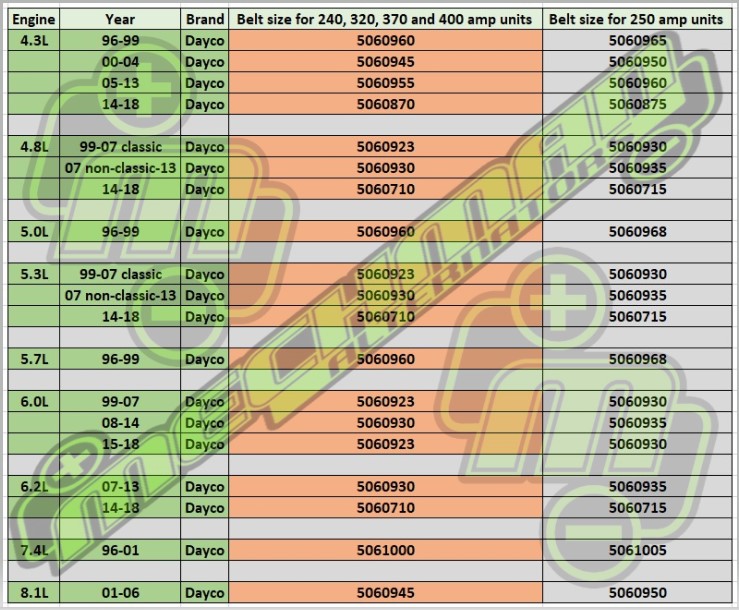
Popular GM truck / SUV belt part number applications

Charge & ground cable wire gauge sizing
Common Questions
Will installing a higher-amperage alternator damage my vehicle or battery?
No. As long as your batteries are in good condition and correctly sized charge and ground cables are installed properly, nothing on the vehicle is adversely affected.
My vehicle's alternator is computer-controlled. Will a higher-output alternator work?
Yes, as long as it's installed properly. Some PCM-controlled vehicles require specific cable routing, and instructions are provided. A Mechman high-output alternator works fine and supplies more amperage than the OEM unit.
If I install a higher-output alternator, will my charging voltage be higher than stock?
Usually no. Most Mechman alternators are built to operate at OEM voltage on purpose, so the vehicle isn't harmed by higher-than-stock charging voltage. A higher-amperage unit actually keeps voltage closer to OEM when the system is drawing more current. If you need higher-than-OEM voltage, ask a sales rep about a custom adjustable-voltage build.
Will a higher-amperage alternator draw more horsepower or hurt my fuel economy?
Only under load. The more amperage an alternator actually makes, the more horsepower it takes to turn it — but alternators are regulated, so unless there's a heavy electrical load, a higher-amperage unit creates no more drag on the engine than the OEM alternator.
Can a 2-pin GM regulator be used in external-regulator applications?
No. The GM 2-pin is ECU-controlled and differs greatly from a terminal-block or Mopar/Dodge-style regulator. If you need external regulation, call or email us to discuss and set it up.
Can you spin an alternator backwards?
Short answer: yes. Long answer: no. The alternator will charge spinning backwards, but efficiency drops nearly 40% because the internal fan isn't reversed. Reverse-rotation applications use special rotors and fans to restore efficiency, cooling, and durability.
My battery is completely dead. Will my alternator recharge it?
It can, but avoid this at all costs. Alternators are designed to sustain a battery's charge, not to recharge a dead or very low battery. Asking an alternator to revive a dead battery overworks it and shortens its life — charge a flat battery with a proper battery charger first.
Need Step-by-Step Install Instructions?
Find model-specific Instruction Guides for your Mechman® alternator — wiring, cable routing, and PCM-controlled vehicle notes.
Still Have Questions?
Talk to a Mechman® Expert
Custom voltage, external regulation, reverse rotation, multi-alternator builds — if your application is unusual, we’ll help you spec it right.